
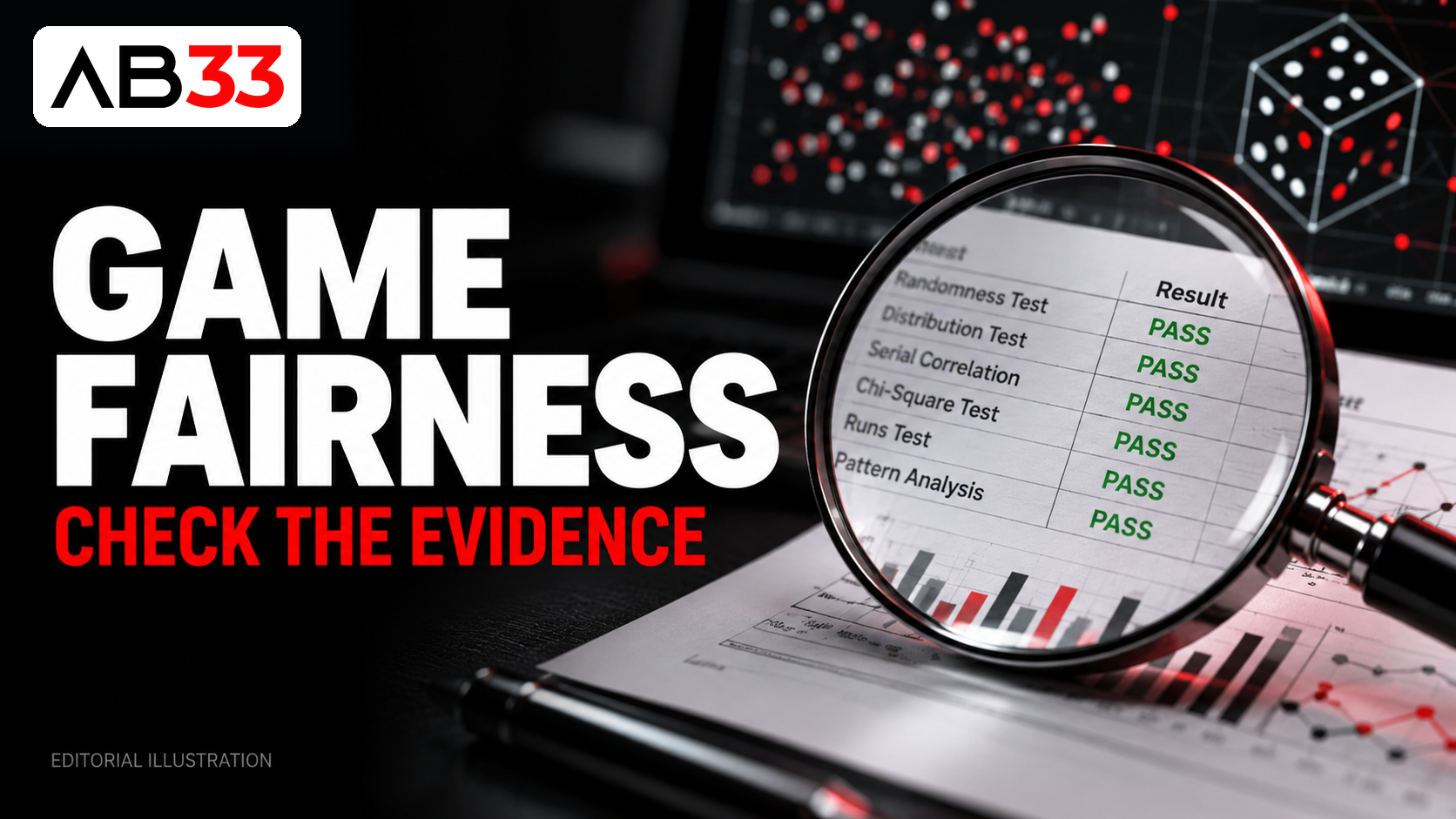
Game fairness is about whether a game operates according to its published rules and mathematical design. It does not mean that a player will win, recover losses or receive the advertised return in a short session. A useful assessment separates the game rules, random-result generation and the evidence supporting any testing claim.
This article explains how to read that evidence. It does not certify AB33 or any provider, and it does not establish that a particular game holds a licence or test certificate.
Start with the exact game and its rules
Record the game name, provider and version or configuration where displayed. Read the help screen for the winning conditions, stake calculation, feature rules and any stated return-to-player value. A familiar title or logo is not enough to show that two versions use identical rules.
The AB33 slot paytable guide explains how to read title-level rules. If a claim elsewhere conflicts with the current game information, pause and ask for clarification rather than choosing the more attractive claim.
What independent testing can examine
Testing can cover more than the random number generator. As one jurisdiction-specific example, the UK Gambling Commission's testing procedure describes checks of RNG implementation and output, game mathematics, software behaviour and the rules shown to players.
Its procedure also identifies report details such as the test house, testing date, certificate reference, game version, RTP, scope and result. These details matter because evidence for one version or limited change should not be treated as proof about every game supplied by the same company.
These are examples from Great Britain's regulatory framework. They are not evidence that AB33 is licensed by that regulator or that an AB33 game has passed those tests.
How to read a testing or certification claim
If a game or operator makes a testing claim, look for information that can be independently checked:
- Who performed the testing, and where can that organisation be verified?
- Which game, software version and configuration does the report cover?
- When was the assessment completed?
- What was tested, and were limitations or conditions stated?
- Does the certificate reference match the source record rather than only an image or logo?
If the relevant evidence is unavailable, describe the claim as unverified. Do not fill the gap with assumptions about a provider's reputation or a game's popularity.
RTP is not a personal result guarantee
Return to player describes a theoretical long-run return for a game's stated model. It is not a promise about an individual account, a session or the next round. Random short-term results can differ substantially from that figure.
Our guide to odds, RTP and house edge explains the distinction. Watching a short run of wins or losses cannot replace a technical assessment, and a losing run does not make a win due.
Testing does not end every question
The UK Gambling Commission explains that operators within its framework must also monitor games after release. A pre-release test and ongoing checks answer different questions. A certificate is not a prediction of results or a substitute for clear current rules.
If you notice a mismatch between a displayed rule and a result, keep the game name, approximate time, relevant rule and non-sensitive error details. Use an official support route and a redacted screenshot where useful. Never share a password or one-time code in a support message.
Only adults of legal gambling age should participate where gambling is lawful and available. Set limits, never chase losses and stop if play is no longer recreational.