
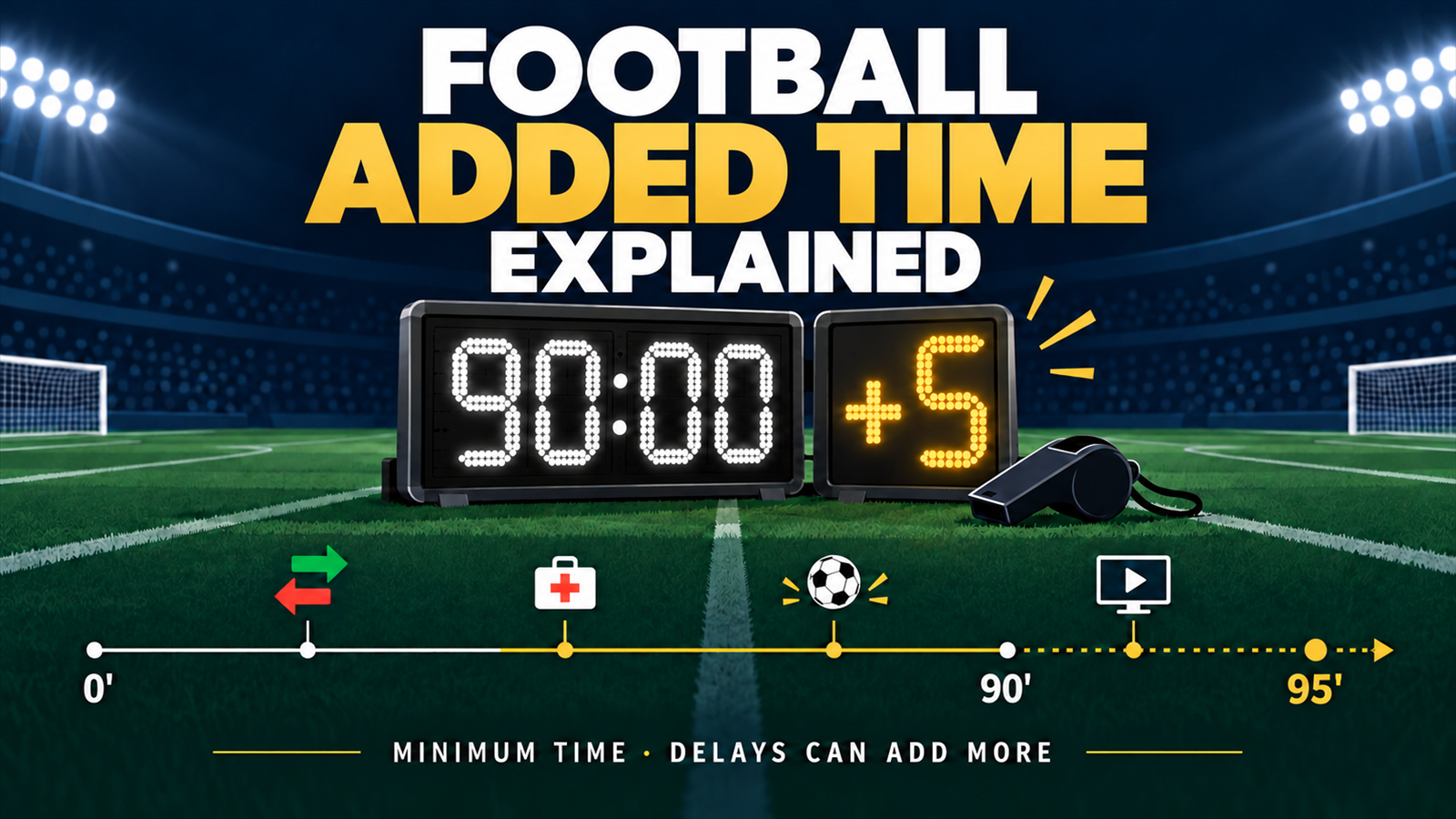
Football matches do not always end when the stadium clock first reaches 90:00. The referee allows for playing time lost during each half, and the number shown by the fourth official is a minimum rather than a guaranteed finishing point. Understanding that distinction makes late-match events much easier to follow.
This guide uses the IFAB 2026/27 Laws of the Game, checked on 9 October 2026. It explains the general law, not a prediction about how long a particular match will run.
Added time is part of the same half
A standard adult match has two equal 45-minute halves unless the competition rules and participating teams permit a different duration. The referee is the timekeeper. When time has been lost during a half, the referee allows for it before ending that half.
Added time is therefore not a separate period with a new score or reset. A goal at 90+4 belongs to the second half. The same principle applies to the end of the first half, even though broadcasts may focus more heavily on late events after 90 minutes.
Do not confuse added time with extra time. Added time compensates for delays inside a half. Extra time is a competition format used after regulation time when rules require a winner, usually as two further periods. The competition regulations determine whether extra time, penalties or another tie-breaking method applies.
Which delays can be included
IFAB Law 7 lists several reasons for allowing time lost:
- substitutions;
- assessment or removal of injured players;
- time-wasting;
- disciplinary sanctions;
- medical stoppages permitted by competition rules;
- delays connected with video checks and reviews;
- goal celebrations; and
- another significant delay to a restart, including outside interference.
The list explains why two halves with a similar number of ordinary stoppages can receive different allowances. A substitution completed promptly and a lengthy injury assessment do not consume the same amount of playing time. A video review can also continue for much longer than a quick check.
Routine restarts are normal parts of football. The question is not how many throw-ins or goal kicks occurred, but how much playing time the referee considers to have been lost through the relevant delays. Our guide to when the ball is out of play explains the boundary decisions that lead to those restarts.
The board shows a minimum
Near the end of each half, the fourth official indicates the minimum additional time decided by the referee. If the board shows +5, the referee intends to allow at least five additional minutes.
The match does not have to end at exactly 95:00. If a player needs treatment at 92:00, a substitution takes a long time, or another substantial delay occurs during the added period, the referee can extend the half further. Under Law 7, the announced additional time may be increased but not reduced.
This is why a broadcast clock can pass the displayed number without an error. The board is not a countdown that automatically ends play. It communicates the minimum allowance based on information available when it is shown.
Why the final whistle may not match a broadcast clock
The referee controls the official time. A television graphic, live-score page or stadium display is a useful reference, but it is not the legal timekeeping decision. Different services may also start, pause or update their visible clocks at slightly different moments.
For a disputed timeline, record the competition, teams, half, displayed added time and the source of the clock. Treat a provider timestamp as a record of that feed, not proof that the referee had to stop play at the same second.
The whistle can also follow the completion of an immediate phase rather than the instant a public display changes. Viewers should rely on the referee's signal and the official match record before treating the result as final.
A penalty can extend the half
Law 7 states that if a penalty kick has to be taken or retaken at the end of a half, the half is extended until the penalty kick is completed. This is a specific rule, not ordinary discretionary added time.
The outcome of the kick determines the next decision under the penalty procedure. The match does not require a ceremonial restart after a goal if the extended half has ended. For other stoppages, the relevant restart still matters; our guide to direct and indirect free kicks explains how the referee's signal changes what can happen next.
A simple viewing checklist
When a match reaches the final minute:
- Check whether the clock is in regulation time, added time or competition extra time.
- Read the board as a minimum, not an exact scheduled finishing second.
- Note any injury, substitution, review, celebration or delayed restart after the board appears.
- Use the referee's final whistle and the official result as the decisive end point.
- If two feeds disagree, compare their timestamps and update times instead of assuming one is deliberately wrong.
These steps describe what happened without turning the visible clock into a prediction. Added time can explain why play continues; it cannot tell a viewer which team will score or what the final result will be.
Keep account access separate from match rules
This article is an independent explanation of the football law and does not promise any result. Sponsored account access: if you choose to visit the customer platform, use AB33win3 and verify the domain before entering account details. Never share a password or one-time verification code.