
A casino-related homepage can place a broad category row above a second set of labelled cards. Both layers help a visitor browse, but they do not provide the same information. A category names a type of content. A card can identify another destination within that category. Neither, by itself, supplies the rules of the product that may appear next.
This AB33 guide reads the supplied desktop homepage in that order: category, card, then product information. The AB33 homepage is the brand destination associated with the screenshot. The purpose is to explain the visible hierarchy, not to claim that every pictured route was opened or tested with a member account.
The category row gives the first layer of context
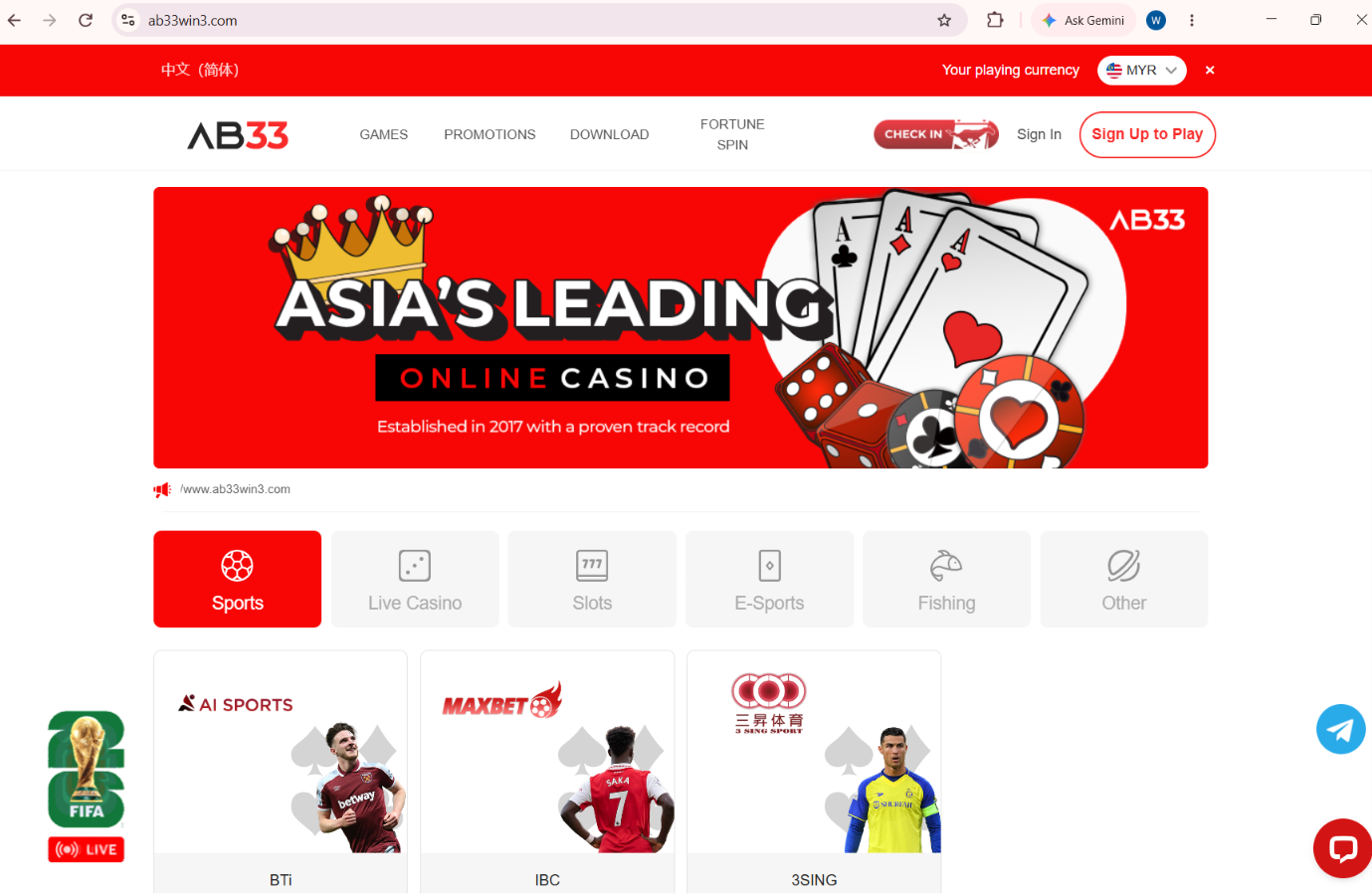
The supplied image displays Sports, Live Casino, Slots, E-Sports, Fishing and Other as separate tiles. These are useful starting labels because they prevent every activity being treated as a single undifferentiated game. Read the selected category before interpreting the cards farther down the page.
In this capture, the Sports tile is highlighted. That detail matters when describing what the lower cards represent in the picture. It is not evidence that the visible cards form the complete sports offering, or that other categories have identical layouts. The screenshot records one selected view rather than every possible state of the homepage.
A card's logo and caption need careful reading
The row beneath the category tiles contains branded artwork and shorter labels. Describe the actual wording if you need to identify a particular card. Do not silently turn a logo, a caption and a destination into the same kind of name; an interface can use each for a different purpose.
A visible brand mark also does not establish exclusivity, ownership or a current contractual relationship. Those claims require evidence beyond the screenshot. For an ordinary navigation question, the card's position, visible label and selected category are usually enough to explain what you mean without making a claim about the businesses involved.
Sports and live tables do not share one rulebook
A sports section concerns events and the information attached to a selected competition or market. A live-table section concerns the particular table, variant and rules being presented. Seeing both labels on a homepage does not make their outcomes, limits or information requirements interchangeable.
If you follow a category, identify the actual product before interpreting any number. A match score, a table limit and a game's theoretical return describe different things. The useful next step is to find the information panel relevant to that product, rather than apply a rule remembered from a different category.
A slot tile cannot supply the paytable
A title image may help someone find a game, but its artwork is not a replacement for the game's paytable and feature explanation. Look for the precise title or version, stake units, symbol rules and conditions that apply to any feature being described. A familiar-looking thumbnail cannot establish all of those details.
The UK Gambling Commission's general explanation of return to player describes RTP as an average across substantial play, not the return from each individual session. That is background terminology, not a statement that AB33 is regulated by that authority or that a particular pictured game carries a verified RTP.
Account and promotion controls are separate routes
The header contains account-entry controls, while promotional information has its own destination. A visitor returning to a profile has a different task from someone reading an offer. Use the AB33 sign-in page for the relevant account route, and distinguish it from a general homepage category.
The AB33 promotions page is the supplied route for offer-specific reading. A banner or category tile does not establish who qualifies for an offer, which products count or whether conditions have changed. Read the complete current terms rather than infer them from the colour or position of a control.
Keep a precise description when asking for help
If you cannot find the intended information, note the selected category, the card's visible wording and the page you reached. A screenshot can help show the sequence, but remove personal account details that are unnecessary. Do not include a password or one-time code in an ordinary explanation of a navigation problem.
The resulting description should stay within the evidence: “Sports was selected, and this labelled card was visible” is a concrete observation. It does not claim that a game launched, a payment completed or a result was guaranteed. Good navigation notes make the next question clearer without pretending the homepage contains every answer.
Frequently asked questions
Is a category tile the same as a game's rules?
No. It is a navigation label; the actual product needs its own information.
Does a logo prove an exclusive partnership?
No. The screenshot alone cannot establish that relationship.
Can RTP predict the return from one session?
No. It describes a broader average rather than an individual-session promise.
Do the homepage images prove that account routes were tested?
No. They show the captured layout and controls, not completed account actions.
Brand information: AB33.